


Regulatory Compliance Workflow for Financial Institutions
- Marensa Advisory

- Jan 20
- 6 min read
Updated: Jan 21

Managing regulatory compliance across United Arab Emirates financial institutions brings constant challenge, especially as global and GCC standards shift. Gaps in workflow documentation, unclear accountability, or outdated training can expose risk far beyond local boundaries. Establishing foundational compliance requirements using Basel Committee and Federal Reserve guidance helps UAE-based teams develop frameworks that fit their unique risk profiles while enabling operational resilience and precise oversight required for international business.
Table of Contents
Step 1: Establish foundational compliance requirements
Building a robust compliance framework starts with understanding the core requirements specific to your financial institution. Financial organizations must develop comprehensive policies that address regulatory expectations and potential risk areas. The Basel Committee guidelines emphasize creating tailored compliance strategies that match your institution’s unique operational landscape.
To establish effective foundational compliance requirements, start by conducting a thorough risk assessment. This involves mapping out all potential compliance vulnerabilities across departments such as lending, investments, customer onboarding, and transaction monitoring. Your assessment should systematically document existing controls, identify gaps, and prioritize remediation strategies. The Federal Reserve’s risk focused supervision program recommends creating detailed documentation that demonstrates how your institution actively manages and mitigates compliance risks.
Successful compliance frameworks require continuous monitoring and periodic updates. Design flexible policies that can adapt to changing regulatory landscapes while maintaining strict adherence to core principles. Regular staff training, clear reporting mechanisms, and management accountability are critical components of a sustainable compliance strategy.
Pro Tip: Develop a centralized compliance dashboard that provides real time visibility into your institution’s regulatory risk profile and allows immediate intervention when potential issues emerge.
Here’s a summary of foundational compliance framework components and their business impact:
Component | Main Purpose | Business Impact |
Policy Development | Set regulatory expectations | Reduces compliance risk |
Risk Assessment | Identify and prioritize vulnerabilities | Improves resource allocation |
Staff Training | Build regulatory knowledge | Enhances operational accuracy |
Monitoring System | Track compliance status in real time | Enables faster issue response |
Step 2: Develop tailored workflow documentation
Creating comprehensive compliance workflow documentation requires a strategic approach that maps out your organization’s specific regulatory requirements and operational processes. FINRA compliance tools provide valuable templates and frameworks to help financial institutions develop precise supervisory procedures that address their unique business landscape.
Begin by conducting a comprehensive assessment of your current workflows, identifying potential compliance gaps and risk areas. Use the IMF’s compliance risk management guidelines to structure your documentation systematically. Your workflow documentation should include clear segments such as risk assessment methodologies, detailed process maps, accountability matrices, reporting mechanisms, and specific protocols for handling compliance exceptions.

Ensure your documentation remains dynamic and adaptable. Regular reviews and updates are critical to maintaining relevance in a rapidly changing regulatory environment. Incorporate feedback mechanisms that allow frontline staff to contribute insights and help refine compliance workflows continuously. Documentation should not be a static document but a living resource that evolves with your organization’s growth and changing regulatory requirements.
Pro Tip: Implement a digital workflow management system that allows real time tracking and version control of your compliance documentation to ensure all team members always access the most current guidelines.
Step 3: Implement operational controls and oversight
Designing effective operational controls requires a comprehensive approach that addresses potential risks across your entire financial institution. The Financial Stability Board’s risk management toolkit provides critical guidance for establishing robust oversight mechanisms that protect your organization from potential vulnerabilities.
Begin by mapping out all critical operational processes and identifying potential risk points. Basel Committee operational resilience principles recommend developing a comprehensive governance framework that includes clear accountability structures, detailed risk assessment protocols, and responsive incident management procedures. Focus on creating multiple layers of control that include preventive measures, detective controls, and corrective action mechanisms.
Establish a dynamic oversight system that continuously monitors and evaluates operational risks. This involves creating real time reporting mechanisms, conducting regular internal audits, and maintaining flexible response protocols. Your control framework should be adaptable enough to respond quickly to emerging risks while maintaining consistent compliance standards across all organizational levels.
Pro Tip: Create a centralized risk dashboard that provides instant visibility into your operational control effectiveness and enables rapid strategic decision making.
Step 4: Train teams on regulatory procedures
Developing an effective regulatory training program requires a strategic approach that transforms complex compliance requirements into actionable knowledge for your team. FINRA’s Regulatory Element Learning Plan provides a comprehensive framework for creating targeted training that addresses specific regulatory challenges across different organizational roles.
Design a multi tiered training approach that combines theoretical knowledge with practical application. The BIS IMF Supervisory and Regulatory Online Course suggests implementing training modules that cover key areas such as regulatory capital, prudential requirements, and supervisory tools. Develop interactive training sessions that include real world scenarios, case studies, and hands on exercises to help team members understand how regulatory procedures translate into daily operational practices.
Ensure your training program remains dynamic and responsive to changing regulatory landscapes. Implement a continuous learning model that includes regular refresher courses, periodic assessments, and mechanisms for tracking individual and team compliance knowledge progression. Create a feedback loop that allows team members to share insights and challenges encountered during regulatory implementation, which can further refine your training approach.
Pro Tip: Develop a digital learning management system that tracks individual training progress and provides personalized learning paths based on each team members specific role and compliance requirements.
Step 5: Verify effectiveness through ongoing testing
Establishing a robust verification process is crucial for maintaining the integrity of your regulatory compliance workflow. OECD’s regulatory performance measurement highlights the importance of evidence based approaches that continuously validate your compliance framework through systematic evaluation and adaptive strategies.
Implement a comprehensive testing methodology that goes beyond traditional audit approaches. The IMF’s technical assessment guidelines recommend creating a multi layered testing strategy that includes periodic risk assessments, scenario simulations, and detailed compliance impact analyses. Design tests that challenge your existing controls by introducing complex scenarios that mirror real world regulatory challenges, allowing you to identify potential weaknesses before they become significant compliance issues.
Create a feedback and improvement cycle that transforms testing results into actionable insights. This means establishing clear mechanisms for documenting test findings, quickly addressing identified gaps, and developing targeted remediation plans. Your testing approach should be dynamic, with continuous monitoring and regular recalibration of compliance controls to ensure they remain effective in an evolving regulatory landscape.
Pro Tip: Develop an automated compliance testing dashboard that provides real time insights into your regulatory control effectiveness and flags potential risk areas before they escalate.
Compare key features of operational oversight and ongoing verification for compliance effectiveness:
Area | Operational Oversight | Ongoing Testing |
Focus | Real time risk detection | Periodic effectiveness validation |
Tools | Dashboards, internal audits | Simulations, compliance analytics |
Response Mechanism | Immediate action protocols | Documented remediation plans |
Business Value | Prevents major compliance gaps | Ensures controls remain effective |
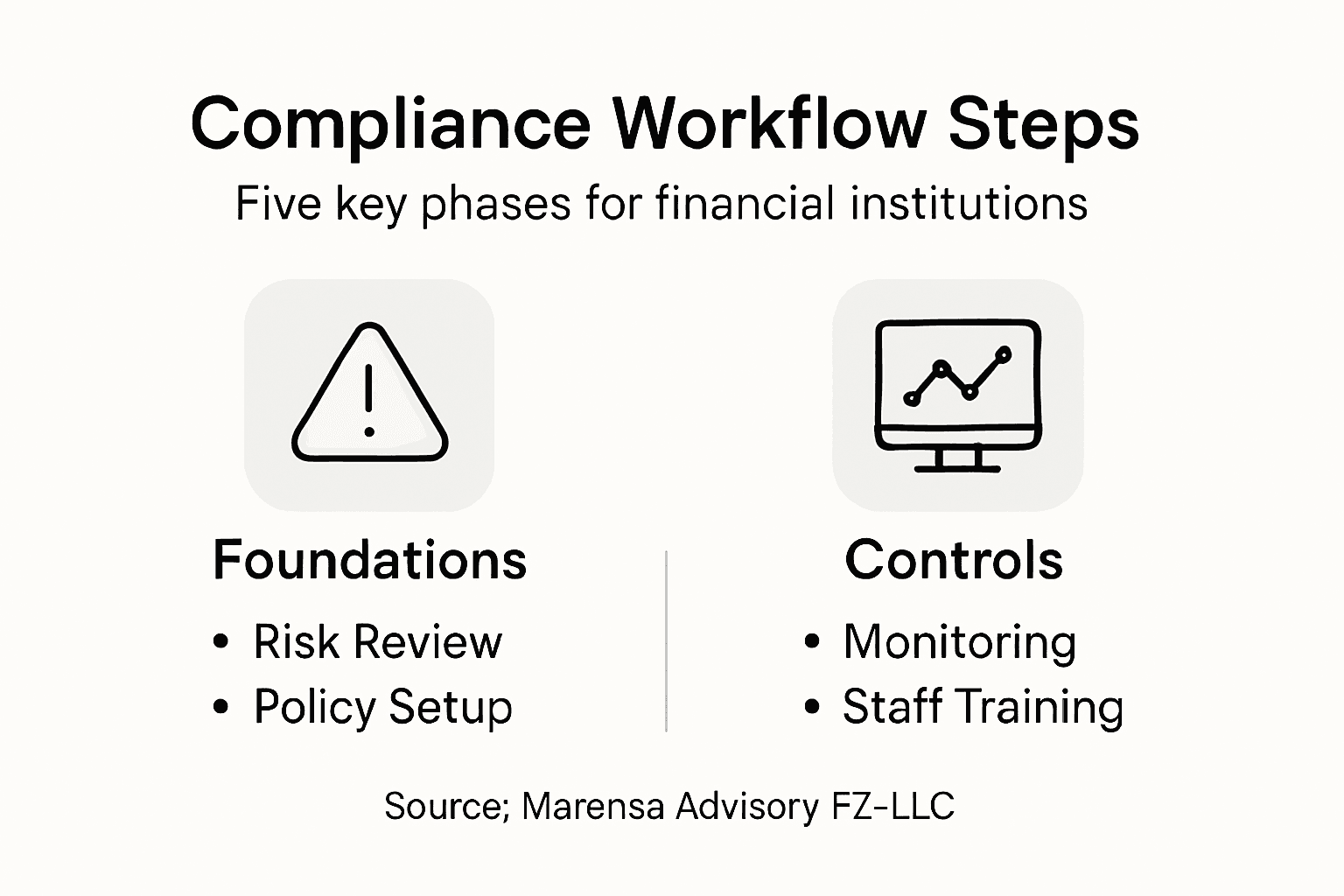
Strengthen Your Regulatory Compliance Workflow with Expert Guidance
Financial institutions face complex challenges in building and maintaining effective regulatory compliance workflows. From establishing foundational compliance requirements and developing tailored workflows to implementing operational controls and ongoing verification, the need for precise, adaptive, and practical solutions is paramount. If you are striving to reduce compliance risk, enhance real-time monitoring, and train your teams on ever-evolving regulatory procedures, you are not alone.
At Marensa Advisory FZ-LLC, we specialize in helping financial services firms design and implement governance, risk, and compliance frameworks that align with your unique business operations. Our deep expertise covers critical areas such as regulatory and compliance advisory, AML/CFT frameworks, licensing support, and outsourced compliance roles like MLRO. We focus on translating your compliance challenges into practical, sustainable solutions that withstand regulatory scrutiny across the GCC, Africa, Europe, and North America.
Ready to transform your compliance workflow into a robust, auditable, and flexible framework? Visit Marensa Advisory today to explore how our customized consulting services can help you establish operational controls, manage risk effectively, and maintain ongoing compliance excellence. Take proactive steps now to secure your institution’s regulatory future by connecting with our experts and ensuring your policies, training, and verification methods keep pace with global standards.
Frequently Asked Questions
What are the core components of a regulatory compliance workflow for financial institutions?
A regulatory compliance workflow typically includes policy development, risk assessment, staff training, monitoring systems, and ongoing testing. Start by outlining these components in a detailed compliance framework to ensure that your institution meets all regulatory expectations.
How can I assess the compliance risks in my financial institution?
Conduct a thorough risk assessment by mapping out potential compliance vulnerabilities across all departments. Document existing controls, identify gaps, and prioritize remediation strategies to systematically address these vulnerabilities.
What steps should I take to train my team on regulatory compliance procedures?
Develop a multi-tiered training program that combines theoretical knowledge with practical applications, ensuring team members understand daily operational practices related to compliance. Implement regular refresher courses and assessments to keep knowledge current and relevant.
How do I verify the effectiveness of my compliance framework?
Establish a robust testing methodology that includes periodic risk assessments and scenario simulations to challenge existing controls. Create a feedback loop to document findings and address any identified gaps promptly, ensuring your compliance controls remain effective.
What tools can I use to track compliance workflows in real time?
Consider implementing a digital compliance dashboard that provides visibility into your regulatory risk profile. This dashboard can help you monitor compliance status and intervene quickly when potential issues arise, allowing for immediate mitigation strategies.


Comments