


Role of Compliance Policies in Financial Institutions
- Marensa Advisory

- Feb 4
- 8 min read

Mistaking compliance policies for rigid rulebooks can leave financial institutions vulnerable to regulatory penalties and reputational harm. In the rapidly evolving environment across the GCC region, every compliance officer faces the challenge of moving beyond common misconceptions and building frameworks that offer true organizational value. This article highlights compliance policies as dynamic instruments that protect institutions, clarifies widespread misunderstandings, and explains how integrated approaches lead to resilient and responsible business practices.
Table of Contents
Key Takeaways
Point | Details |
Importance of Compliance Policies | Compliance policies are strategic tools for financial institutions, protecting against legal risks and enhancing performance. |
Common Misconceptions | Compliance is often seen as a burden; in reality, it fosters responsible business practices and organizational growth. |
Integration Across Organization | Successful implementation requires alignment from all levels of the organization, promoting a cohesive approach. |
Dynamic Nature of Compliance | Compliance frameworks should be adaptable, evolving with regulatory changes to enhance organizational resilience. |
Defining Compliance Policies and Common Misconceptions
Compliance policies serve as strategic frameworks that guide financial institutions in adhering to regulatory standards and managing potential risks. These comprehensive guidelines outline the specific procedures, protocols, and expectations that organizations must follow to maintain legal and ethical operational standards.
At their core, compliance policies represent more than just a set of rules. They are dynamic instruments designed to protect financial institutions from potential legal vulnerabilities, reputational damage, and financial penalties. Comprehensive compliance frameworks help organizations transform regulatory challenges into strategic opportunities for growth and stability.
Key components of effective compliance policies typically include:
Clear articulation of organizational expectations
Specific procedures for risk identification
Mechanisms for reporting potential violations
Training protocols for staff members
Regular monitoring and assessment processes
Defined consequences for non-compliance
Despite their critical importance, several misconceptions persist about compliance policies in financial institutions. Many professionals mistakenly view these frameworks as bureaucratic obstacles rather than strategic assets that can enhance organizational performance and risk management.
Compliance is not about restriction—it’s about creating a structured environment that enables sustainable and responsible business practices.
Common misconceptions about compliance policies include:
Compliance is purely a legal requirement
These policies are static and unchanging
Compliance is only relevant for large organizations
Implementing policies is a one-time effort
Compliance departments operate in isolation
Organizational alignment is crucial for successful policy implementation. Compliance policies must be integrated seamlessly across all operational levels, from executive leadership to frontline staff, ensuring a cohesive and proactive approach to regulatory adherence.
Pro tip: Develop a dynamic compliance framework that views regulations as opportunities for organizational improvement rather than mere checkboxes.
Key Types of Compliance Policies in Finance
Financial institutions navigate complex regulatory landscapes by implementing various compliance policy types that address critical operational, ethical, and legal requirements. Comprehensive compliance frameworks play a crucial role in maintaining institutional integrity and managing potential risks across multiple domains.
The primary types of compliance policies in financial institutions can be categorized into several key areas:
Regulatory Compliance: Ensuring adherence to government and industry-specific regulations
Financial Reporting Compliance: Maintaining accurate and transparent financial documentation
Data Privacy and Security Policies: Protecting sensitive customer and organizational information
Ethical Conduct Policies: Establishing standards for professional behavior and integrity
Risk Management Compliance: Identifying, assessing, and mitigating potential institutional risks
Anti-Money Laundering (AML) Policies: Preventing financial crimes and ensuring transaction integrity
Each compliance policy type serves a unique and critical function in maintaining the overall health and reliability of financial institutions. Regulatory compliance, for instance, requires organizations to stay current with constantly evolving legal requirements across different jurisdictions and operational contexts.
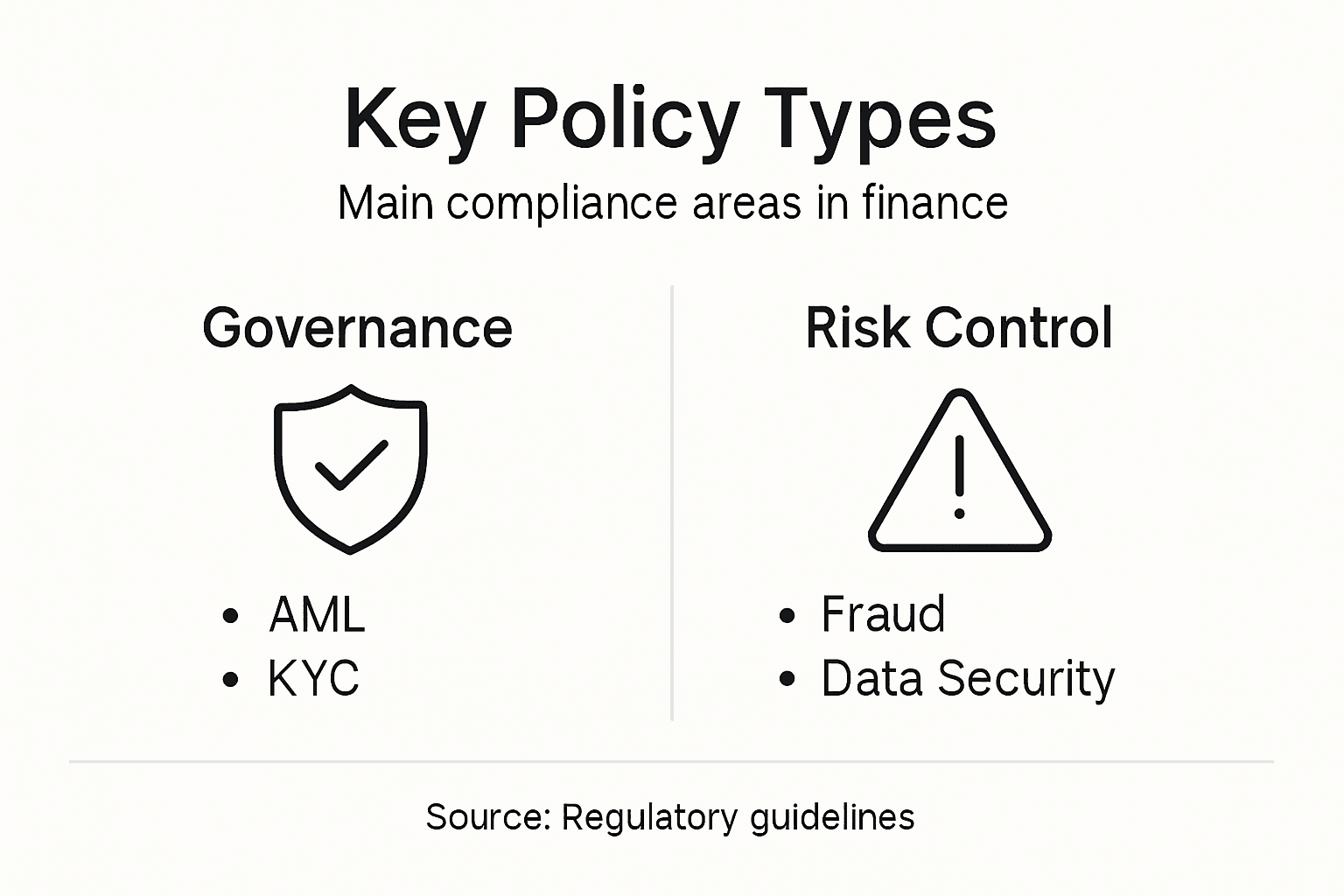
Here’s how major compliance policy types impact financial institutions:
Policy Type | Main Goal | Typical Challenges | Business Impact |
Regulatory Compliance | Meet legal obligations | Constant regulatory changes | Avoid fines and penalties |
Data Privacy & Security | Protect sensitive data | Cybersecurity risks | Build customer trust |
Ethical Conduct | Set professional standards | Ethical dilemma management | Protect reputation |
Risk Management | Mitigate operational risks | Complex risk assessment | Ensure business continuity |
Effective compliance policies are not mere bureaucratic exercises, but strategic tools that protect both the institution and its stakeholders.
The implementation of these policies involves multiple layers of organizational commitment:
Developing clear and comprehensive policy documentation
Conducting regular staff training and awareness programs
Establishing robust monitoring and reporting mechanisms
Creating accountability structures
Implementing continuous improvement processes
Technological integration has become increasingly important in managing these complex compliance requirements. Modern financial institutions leverage advanced software and analytics tools to track, report, and ensure adherence to various policy mandates.
Pro tip: Develop a holistic compliance approach that views policies as dynamic frameworks for organizational excellence, not just static regulatory checkboxes.
Core Elements and Structure of Effective Policies
Developing a robust compliance policy framework requires strategic architectural thinking and comprehensive organizational alignment. Compliance management systems represent the foundational infrastructure that enables financial institutions to create, implement, and maintain effective regulatory controls.
The core elements of an effective compliance policy structure typically encompass several critical dimensions:
Governance and Oversight: Clear accountability from board and senior management
Risk Assessment: Systematic identification and evaluation of potential compliance risks
Written Documentation: Comprehensive and precise policy guidelines
Training Programs: Continuous education and awareness initiatives
Monitoring Mechanisms: Regular auditing and performance evaluation processes
Reporting Frameworks: Transparent communication channels for compliance issues
Organizational positioning plays a crucial role in compliance policy effectiveness. The compliance function must maintain independence while being strategically integrated across different operational units to ensure comprehensive coverage and meaningful impact.
Successful compliance policies transform regulatory requirements from bureaucratic constraints into strategic organizational capabilities.
Implementing a comprehensive compliance policy structure involves multiple sophisticated steps:
Conducting thorough initial risk assessments
Developing clear, actionable policy documentation
Creating robust training and communication strategies
Establishing independent monitoring processes
Implementing continuous improvement mechanisms
Technological infrastructure has become increasingly critical in supporting complex compliance policy frameworks. Advanced analytics, artificial intelligence, and integrated management systems now provide unprecedented capabilities for real-time monitoring and risk management.

Pro tip: Design compliance policies as dynamic, adaptable frameworks that evolve with changing regulatory landscapes and organizational needs.
Regulatory Framework Influencing Policy Design
Navigating the complex landscape of financial regulations requires sophisticated policy design strategies that anticipate and address evolving compliance challenges. Regulatory impact assessment has become a critical mechanism for understanding how policy frameworks translate theoretical guidelines into practical organizational controls.
The regulatory framework influencing compliance policy design encompasses multiple critical dimensions:
Global Regulatory Standards: International guidelines from Basel Accords and FATF
Regional Compliance Requirements: Jurisdiction-specific legal mandates
Industry-Specific Regulations: Targeted rules for different financial sectors
Risk-Based Approach: Dynamic frameworks adapting to emerging threats
Transparency and Reporting Obligations: Mandatory disclosure mechanisms
Consumer Protection Guidelines: Regulations ensuring client rights and safety
Regulatory complexity demands a multifaceted approach to policy design. Financial institutions must develop adaptive frameworks that can quickly respond to changing legal landscapes while maintaining robust internal control mechanisms.
Effective regulatory frameworks transform compliance from a mandatory checkbox into a strategic organizational capability.
Key considerations in designing regulatory-compliant policies include:
Understanding granular regulatory requirements
Mapping organizational processes against regulatory expectations
Creating scalable and flexible policy architectures
Implementing continuous monitoring systems
Developing robust documentation and evidence trails
Technological innovation plays an increasingly significant role in regulatory compliance. Advanced analytics, machine learning, and real-time monitoring systems now enable financial institutions to create more responsive and intelligent policy frameworks.
Pro tip: Design compliance policies as living documents that anticipate regulatory shifts and proactively integrate emerging best practices.
Responsibilities and Risks for Compliance Teams
Compliance teams serve as the critical guardians of organizational integrity, navigating increasingly complex regulatory landscapes with strategic precision. Compliance risk management represents a multifaceted challenge that requires comprehensive understanding of legal, operational, and technological risks.
The core responsibilities of compliance teams encompass several critical domains:
Regulatory Monitoring: Tracking and interpreting evolving legal requirements
Risk Assessment: Identifying and evaluating potential compliance vulnerabilities
Policy Development: Creating and updating organizational compliance frameworks
Training and Education: Ensuring staff understanding of compliance protocols
Reporting and Documentation: Maintaining comprehensive evidence of compliance efforts
Stakeholder Communication: Engaging with internal and external regulatory bodies
Organizational risk extends far beyond simple regulatory adherence. Compliance teams must proactively anticipate potential legal, financial, and reputational challenges that could impact the institution’s strategic objectives.
Effective compliance is not about avoiding penalties, but about building a culture of ethical and responsible organizational behavior.
Key risks faced by compliance teams include:
Regulatory complexity and frequent legal changes
Technology-driven compliance challenges
Cross-jurisdictional regulatory variations
Resource and budget constraints
Emerging technological and cybersecurity threats
Technological integration has become increasingly crucial in managing compliance risks. Advanced analytics, artificial intelligence, and machine learning tools now enable more sophisticated and proactive risk management strategies.
Below is a quick reference on technology’s role in compliance management:
Technology Type | Compliance Benefit | Common Use Case |
Analytics Software | Enhance risk detection | Monitor suspicious transactions |
AI & Machine Learning | Automate compliance checks | Fraud pattern recognition |
Reporting Tools | Streamline documentation | Regulatory submissions |
Cybersecurity Systems | Safeguard data integrity | Prevent data breaches |
Pro tip: Develop a dynamic, forward-looking compliance strategy that views regulatory challenges as opportunities for organizational improvement and innovation.
Strengthen Your Compliance Policies with Expert Guidance
Navigating the complex demands of compliance policies and regulatory frameworks presents a real challenge for financial institutions today. From establishing effective governance and risk assessment mechanisms to keeping pace with evolving regulations, the pressure to build robust and dynamic compliance programs can feel overwhelming. If you are seeking to move beyond static checklists and embrace compliance as an opportunity for organizational excellence, tailored support is essential.
At Marensa Advisory FZ-LLC, we specialize in helping financial and non-financial organizations across the GCC, Africa, Europe, and North America design and implement practical compliance frameworks that align with your operations. Whether you need assistance with regulatory compliance, AML/CFT frameworks, or licensing support, our expert team will guide you through every step to ensure your policies not only meet legal requirements but also foster sustainable business growth. Do not let regulatory complexity hold your institution back. Visit Marensa Advisory today to discover how our customized governance, risk, and compliance solutions empower financial institutions to confidently navigate today’s regulatory landscape. Learn more about our regulatory advisory services and get started on fortifying your institution’s compliance foundation now.
Frequently Asked Questions
What are compliance policies in financial institutions?
Compliance policies are strategic frameworks that guide financial institutions in adhering to regulatory standards and managing potential risks, ensuring legal and ethical operational conduct.
Why are compliance policies important for financial institutions?
Compliance policies protect financial institutions from legal vulnerabilities, reputational damage, and financial penalties while enabling a structured environment for responsible business practices.
How often should compliance policies be updated?
Compliance policies should be regularly reviewed and updated to reflect constant regulatory changes and to ensure they remain relevant and effective.
What are the key components of effective compliance policies?
Key components include clear organizational expectations, specific procedures for risk identification, reporting mechanisms for violations, staff training protocols, monitoring processes, and defined consequences for non-compliance.
Recommended

Comments